
Static Drawdown Explained
What Is Static Drawdown? The Short Answer
A static drawdown is a loss floor pinned to your starting balance that does not move with your balance. The firm sets it on day one, off the number you start with, and it stays there until your account steps up a size. Make money and the line holds. Give it back and the line still holds. That is the whole mechanic, and it is the opposite of a trailing drawdown, where the floor chases your account up every time you hit a new high.
Run the math on a $50K account with a 10% static rule. Ten percent of $50,000 is $5,000, so your floor sits at $45,000 and stays at $45,000. Push the account to $58K and the floor is still $45,000. Drop back to $50,100 and you are fine, because the line never crept up behind you. On a trailing model that same run would have dragged the floor to roughly $53,000, and a normal pullback would close you out while you are still in profit. Static gives you back the room you earned instead of tightening the rope as you win.
Static drawdown, plain version: a fixed dollar loss limit measured from your starting balance. It never trails your equity, so banking profit buys you breathing room instead of moving the goalposts.
Now the buying question: which prop firms actually run static? Stampede runs it on every challenge plan, no exceptions. The floor depends on the plan you pick (10% on Classic, 6% on Sprint, 3% on Sprint Turbo), but the type is the same across all three: a fixed dollar line from your starting balance that does not move with your balance. The accounts are simulated and the rule is mechanical, published up front and applied the same to everyone, with no discretionary tightening when you start winning.
If you want the head-to-head first, read the trailing drawdown explainer. New to all of this? Start with what a prop firm is.
Static vs Trailing Drawdown: The One Difference That Matters
Strip away the jargon and there's exactly one thing separating these two models: does your loss floor move or not.
A static drawdown sets your floor once, off your starting balance, and nails it there. Win, lose, double the account, it doesn't matter. The line you can't cross is the same number on day one and day one hundred, until your account steps up a size. A trailing drawdown does the opposite. It pins the floor a fixed distance under your highest point, then drags it up behind you every time you make a new peak. The better you trade, the higher the floor climbs, and on most models it never slides back down when you give profit back.
That single property is why traders pick one over the other, so here's the head-to-head:
| Static drawdown | Trailing drawdown | |
|---|---|---|
| Floor is set from | Your starting balance | Your highest point so far |
| Does the floor move? | No, fixed from day one | Yes, climbs as you profit |
| What happens when you win | Nothing. Floor stays put | Floor ratchets up behind you |
| What happens when you give back | Nothing. Floor stays put | Floor stays at the peak, gap shrinks |
| Can you blow up while still in profit? | No | Yes, on a normal pullback |
| Risk you plan off | One fixed number | A moving target |
Read the last two rows again, because that's where the money is. Under a static floor, your stop-out level is a number you can write on a sticky note and forget. Under a trailing floor, the level you calculated this morning isn't the level you're trading against this afternoon. A good run quietly tightens the rope, and a routine pullback can close an account that's still showing green.
Put real dollars on it. Take a $50K account with a $3,000 buffer. Static parks the floor at $47,000 and leaves it there until your account steps up a size. Trailing also opens at $47,000, but push the account to a $54,000 peak and that floor climbs to $51,000. Now drop back to $50,800, still up $800 from where you started, and the trailing account is done while the static account has $3,800 of room to spare. One trader is out, the other barely noticed. The trade was identical. The rule decided who survived.
That difference is why Stampede runs static on every challenge plan and never makes you guess where your floor will be tomorrow.
How Static Drawdown Works on a $50K Account (Worked Math)
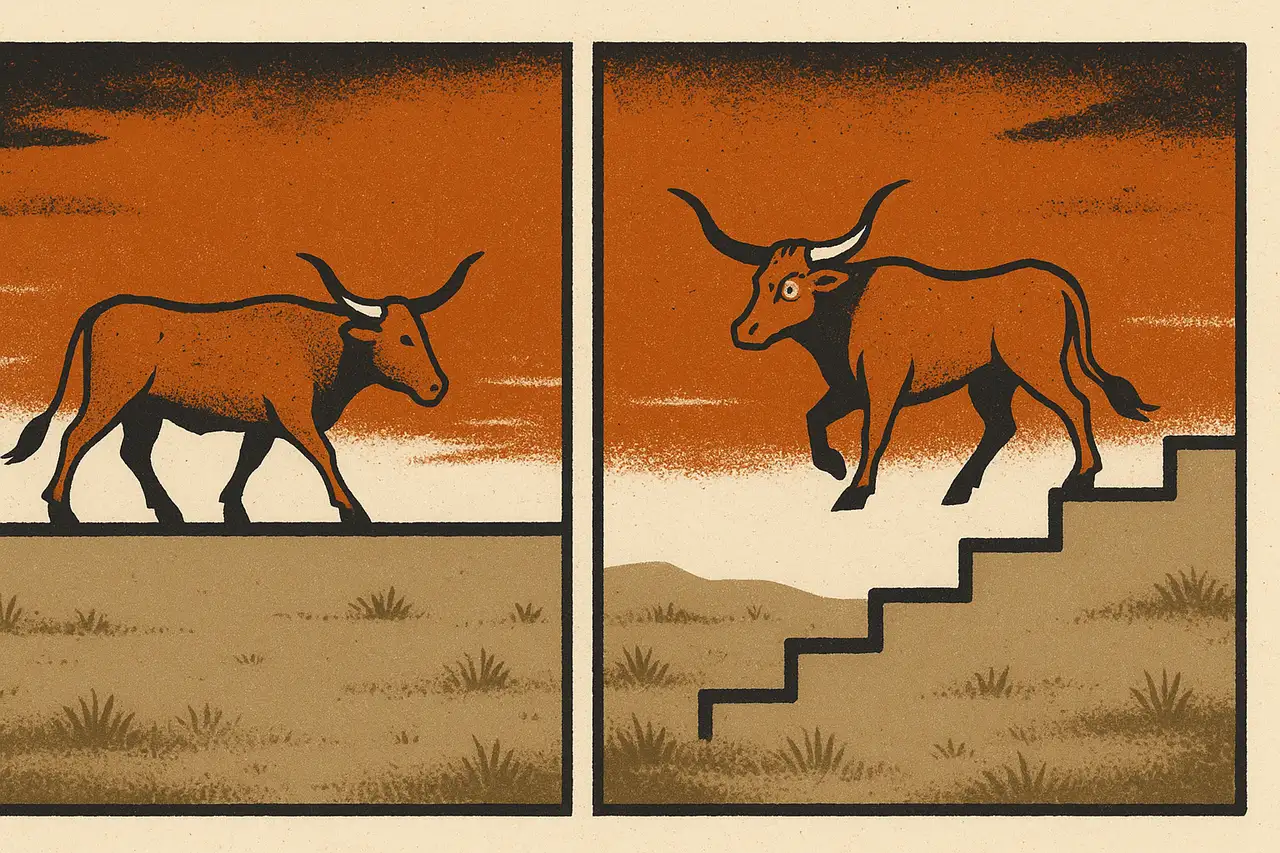
Static drawdown is the easy one to work out, because the number does not move with your balance. Set the floor from your starting balance and it sits there until your account steps up a size.
Take a $50,000 account with a 10% static drawdown. Ten percent of $50,000 is $5,000, so your floor is $45,000. That's it. Whether you run the account to $58,000 or sit flat at $50,000, the line you can't cross stays parked at $45,000. It doesn't chase your peak, it doesn't ratchet up on a green day, and it doesn't tighten while you sleep.
Here's the same account traded out, side by side with a trailing floor set $5,000 under your high-water mark, so you can watch the two split apart:
| Move | Account balance | Static floor (fixed) | Trailing floor (peak minus $5,000) |
|---|---|---|---|
| Start | $50,000 | $45,000 | $45,000 |
| Win to $54,000 | $54,000 | $45,000 | $49,000 |
| Win to $58,000 | $58,000 | $45,000 | $53,000 |
| Give back to $54,000 | $54,000 | $45,000 | $53,000 (locked) |
| Drop to $52,500 | $52,500 | safe | breached |
Look at the last row. You're sitting at $52,500, still up $2,500 from where you started, and the static floor doesn't care: you've got $7,500 of room left. The trailing floor already climbed to $53,000 chasing your $58,000 peak, so the same $52,500 balance busts the account. Same trades, same profit, two completely different outcomes. The only thing that changed is whether the floor moved.
That's the whole appeal of a static floor. When you bank profit, the cushion under you grows because the floor stays put while your balance climbs. Run that $50K account to $58K and you're now $13,000 above the line instead of the $5,000 you started with. On a Stampede account, the room you earn is room you keep.
Pick your buffer, then trade against a number that doesn't chase you.
What Is a 10% Static Drawdown Rule?
A 10% static drawdown rule means your account can lose 10% of its starting balance before it's done, and that floor is fixed from day one. Ten percent of the start, never trailing. On a $10K account the floor is $9,000. Hit it and the account is over. Stay above it and you keep trading, no matter how high you climb in between.
The number scales straight off your starting balance, so the floor is easy to read before you ever place a trade:
| Account size | 10% static drawdown | Floor (can't close below) |
|---|---|---|
| $10,000 | $1,000 | $9,000 |
| $50,000 | $5,000 | $45,000 |
| $100,000 | $10,000 | $90,000 |
That floor does not move with your balance. Run a $50K account up to $58K and the line still sits at $45,000, the same place it started. A trailing rule would have dragged that floor up behind your gains and put you out on a normal pullback while you were still in profit. Static doesn't. The number on the plan is the number until your account steps up a size.
One thing to keep separate: the 10% static drawdown is your total loss limit, not your daily one. Most plans also run a daily loss limit, a smaller cap that resets every session. The static floor is the hard floor for the whole account. The daily limit is the line you can't cross in a single day. Two different rules doing two different jobs. The exact numbers for each plan live on the rules page.
This is the floor Stampede runs on every challenge plan: 10% static on Classic, 6% on Sprint, 3% on Sprint Turbo. Fixed dollar number, printed on the plan, applied the same to everyone. No trailing, no goalpost that moves while you sleep.
Why Static Drawdown Is Fairer (and Why Some Firms Avoid It)
Static drawdown is fairer for one plain reason: the number you agree to on day one is the number that's still there on day ninety. Your loss floor is set off your starting balance, printed on the plan, and it does not move with your balance. You can do your risk math once and trust it until your account steps up a size. With a trailing floor, the line you can't cross chases your equity up every time you bank a win, so a green morning quietly tightens the rope around your afternoon. Static doesn't tighten. It sits where the number says it sits.
Run the contrast on a $50K account. Say the static floor is $45,000. You trade up to a $58K peak, then give some back. Under static, your floor is still $45,000, so you've got room all the way down through a normal pullback. Under a trailing rule, that floor would have ridden up behind your peak, and a routine drawdown could close the account at a balance you're still in profit on. Same trades, same account, two completely different outcomes. The static account is the one where the wins you booked actually buy you breathing room instead of moving the goalposts.
So why do some firms avoid it? Because trailing protects the firm, not you. The floor climbing behind your peak means the firm's downside shrinks every time you profit, and the locked profit can't be handed back to the market. That's defensible underwriting from the firm's side. It's also why so many funded accounts die on green days, on a wick the trader never closed. Trailing dominates futures evaluations for exactly this reason. (Apex runs an intraday-style trailing drawdown, Topstep uses end-of-day trailing, and many multi-asset firms run static. Rules change, so verify the current sheet before you buy.)
Stampede runs static on every challenge plan. The rule is mechanical, printed on the plan and applied the same to everyone, with no discretionary tightening when you start winning. Trailing is a real mechanic some traders pick on purpose. We just don't run it on the challenge, because a floor that moves while you sleep isn't the deal we want to sell. Pick the rule you'd rather trade and take a challenge.
Which Prop Firms Have Static Drawdown?
Short answer: fewer than you'd hope, and almost none on every plan. Static drawdown is the friendlier rule, so firms tend to reserve it for their pricier accounts and run trailing on the cheap ones. A firm can advertise "static drawdown" and still hand you a trailing floor the moment you pick the plan you can actually afford.
Here's how to read the field, and how to check it yourself before you pay a fee.
The list pages are a starting point, not gospel. Sites like PropFirmMatch keep a running list of firms that offer static drawdown. Useful for names, thin on mechanics, and they go stale fast because firms change rules between funding rounds. Use them to build a shortlist, then verify on the firm's own rules page, because the floor you get is the one printed on the plan you buy, not the one in a directory.
Watch the plan, not the brand. Plenty of well-known firms run a mix. The headline says static; the entry-tier or "instant" account quietly runs trailing. So "does firm X have static drawdown" is the wrong question. The right one is "does the specific plan I'm about to buy run static, and is the floor a fixed dollar number from my starting balance." Read the rule sheet for that plan, not the marketing page for the brand.
Futures vs forex changes the odds. Trailing dominates futures evaluations, so a futures trader hunting static is fighting the grain. Forex and multi-asset firms run static more often. Either way the rule is per-plan, so the same checks apply: find the number, confirm it's fixed to your start, confirm it doesn't ratchet.
What to look for on any rules page:
- The word "static" or "fixed," next to a dollar figure. A real static rule names the floor in dollars off your starting balance. If the page only talks about a percentage that "trails your highest balance," that's trailing wearing a friendlier word.
- Confirmation the floor doesn't move on a win. Static means the line sits where it started no matter how high you push. If a green day can tighten tomorrow's floor, it isn't static.
- Per-plan, not per-firm. Check the exact plan you're buying. A firm with static on its top account can still run trailing on the one in your budget.
Stampede runs static on every challenge plan, and the floor is a fixed dollar number set at your starting balance that does not move when you win.
How Stampede Runs Static Drawdown on Every Plan
Stampede runs static drawdown on every challenge plan. Your loss floor is a fixed dollar number, set from your starting balance until your account steps up a size, printed on the plan. It does not trail your equity, it does not ratchet up behind a green day, and it does not silently tighten while you hold a winner. The rule is mechanical: published, fixed, and applied the same to everyone, with no discretionary tightening when you start winning.
Three challenge plans, three buffers, all static:
| Plan | Total drawdown | Daily loss | Type |
|---|---|---|---|
| Classic (2-Step) | 10% | 5% | Static |
| Sprint (1-Step) | 6% | 4% | Static |
| Sprint Turbo (1-Step) | 3% | 3% | Static |
Worked on a $50K Classic: 10% static is a $5,000 buffer, so your floor sits at $45,000 from day one. Run the account to $58K and the floor is still $45,000. On a trailing model that floor would have chased you up to somewhere around $53,000, and a normal pullback off the high could close you out at a balance you are still deep in profit on. Static does not do that. The line sits where the number says it sits, until your account steps up a size.
Same math, tighter buffer, on a $50K Sprint: 6% is a $3,000 floor at $47,000, fixed. On a $50K Sprint Turbo: 3% is a $1,500 floor at $48,500, fixed. The Turbo buffer is the tightest in the lineup, but it is the one thing every trailing firm cannot offer at any size: a line that is the same in the afternoon as it was at the open. See the pricing for what each plan costs.
Static is the challenge mechanic. Stampede Instant is the separate no-evaluation product, and it runs a 6% end-of-day trailing floor instead of static. That floor only steps at the daily close, never intraday, so nothing moves on you mid-trade either, but it is a trail, not a fixed line. If you want a floor that does not move with your balance, that is the challenge. Every challenge plan, static, no exceptions.
Profit split is 80%, with one optional add-on that takes it to 90% for 20% more on the challenge fee, picked at checkout, no other upsells. Payouts are on-demand from your first profitable funded trade, $50 minimum, processed same day. Static drawdown and fast payouts are never sold as upgrades. They are the product.
Pick your buffer. Take a challenge and trade a floor that holds still. Follow the herd.

Static Drawdown FAQ
What is static drawdown in a prop firm?
Static drawdown is a fixed loss floor set from your starting balance that does not move with your balance while you trade. On a $50K account with a 10% static rule, your floor is $45,000 from day one and stays $45,000 whether you run the account to $60K or back to $46K, until the account steps up a size. Unlike trailing drawdown, it doesn't chase your equity up as you profit, so your breach point is a known number, not a moving target.
Which is better, static or trailing drawdown?
For most traders, static is the friendlier rule because it doesn't tighten on you. A trailing floor ratchets up behind your gains, so a normal pullback can close an account you're still in profit on. A static floor sits where the number says it sits, so banking profit buys you breathing room instead of moving the goalposts. Trailing isn't a trick and some traders pick it on purpose, but static is the predictable one.
What is a 10% static drawdown rule?
A 10% static drawdown means your total loss floor is fixed at 10% below your starting balance and does not move with your balance: $45,000 on a $50K account, $9,000 on a $10K account, $90,000 on a $100K account. It's a total drawdown, separate from the daily loss limit, which resets each session. Stampede's Classic plan runs exactly a 10% static total drawdown with a 5% daily loss limit.
Which prop firms have static drawdown?
Many forex and multi-asset firms offer static drawdown on some plans, while most futures evaluations default to trailing, which is why futures traders get caught out by a floor that chases them. Stampede runs static on every challenge plan: Classic at 10%, Sprint at 6%, and Sprint Turbo at 3%, each fixed from your starting balance. Stampede Instant uses 6% end-of-day trailing instead, the version that only updates at the daily close.
What does static drawdown mean in trading?
In trading, static drawdown means your maximum allowed loss is pinned to a fixed dollar level set from your starting balance. It doesn't track your highest equity and it doesn't move on open or closed profit. You size your risk off one number you know on day one, which is why traders find it easier to manage than a trailing floor that keeps climbing as you win.
Does static drawdown move with unrealized profit?
No. A static floor is fixed from your starting balance, so an open winner that spikes and pulls back can't tighten the line. That's the opposite of intraday trailing drawdown, where an unrealized profit spike you never closed can ratchet your floor higher and breach you mid-trade. With static, only your starting balance sets the floor, and it stays put.
Which futures prop firm has static drawdown?
Most futures prop firms run trailing drawdown on their evaluations, so static options are the exception that traders hunt for on forums. Stampede runs static drawdown on every challenge plan rather than only one tier, with the floor fixed from your starting balance and printed on the plan. Check the exact per-plan floors on the rules page before you pick a size.